
If you owe back taxes and have just received an IRS notice, the letter mentions a 433-F form. It means the IRS wants a closer look at your financial life. Many taxpayers freeze at this point, unsure what the government really wants or how much detail they need to share.
Mistakes or missing details can delay payment plans or even lead to tougher IRS actions. Since the IRS uses Form 433-F to decide what you can pay and whether you qualify for relief, knowing how to complete the 433-F form correctly is crucial.
In this blog, we will break down the form step by step, explain when you need it, show you how to fill in each section, and guide you on where to send it. By the end, you’ll understand what the IRS is really looking for and how to give them exactly what they need.
Collection Information Statement
Form 433-F is officially called the Collection Information Statement. The IRS uses it for two main reasons:
- To have a precise picture of your income, assets, debts, and living expenses.
- To determine the kind of tax resolution you qualify for, whether it’s an installment agreement, hardship status, or even a settlement.
It is mainly used for individuals, including wage earners and self-employed taxpayers. Unlike the longer 433-A, the IRS Form 433-F is shorter and more streamlined but still covers every corner of your finances.
When Do You Need to File Form 433-F?
You don’t file this form with your tax return. Instead, you complete Form 433-F when the IRS asks for it or when you request certain types of debt relief programs. The most common situations include:
- You receive a notice from the Automated Collection System asking for financial details.
- You speak to a revenue officer who requires the form.
- You want to set up a long-term installment agreement that the online system won’t cover.
- You are requesting “currently not collectible” status because you can’t afford to pay anything now.
- You are showing proof of hardship to avoid wage garnishment or levies.
Sometimes, small balances can be resolved through the IRS Online Payment Agreement tool without ever touching IRS Form 433-F. But if you owe more than $50,000, have an unsteady income, or run a business on the side, chances are you’ll be asked to complete the full statement.
IRS Tax Form 433-F Instructions
Form 433-F is for the IRS to examine your present financial situation to determine how you will be able to pay the amount of taxes that is outstanding. It gathers information on what you make, what you have, and how you spend it. The form is subdivided, and each section contains certain rules.
The main instructions are simplified here:
- Section A – Accounts: List all checking, savings, money market, and online accounts, even if the balance is zero. Do not list bank loans here. Include business accounts too.
- Section B – Real Estate: Report every property you own or are buying. Include addresses, loan details, and monthly payments. Equity is calculated as value minus what you owe.
- Section C – Other Assets: List vehicles, boats, RVs, whole life insurance cash value, or collectibles. For leases, write “lease” in the year column. Include business tools and intangible assets like patents or domain names.
- Section D – Credit Cards/Digital Assets: Enter all credit cards, even with no balance, plus digital wallets or crypto exchanges with their current value.
- Section E–H – Income and Expenses: Add business accounts receivable, job details, non-wage income, and monthly living costs. Convert non-monthly bills into monthly figures (e.g., weekly × 4.3, quarterly ÷ 3, twice a month × 2, or biweekly × 2.17).
Always keep proof like pay stubs, statements, and bills since the IRS may ask for documentation after reviewing your 433-F form.
How to Prepare Before Filling Out Form 433-F?
Preparation is half the battle. Here’s what to gather before you even pick up a pen:
- Last three months of bank statements.
- Last two months of pay stubs.
- Year-to-date profit and loss if you’re self-employed.
- Recent mortgage or rent statements.
- Current vehicle loan or lease papers.
- Utility bills and health insurance documents.
Keep all these in a folder. When you sit down with IRS Form 433-F, you’ll be ready to fill each section without guessing numbers.
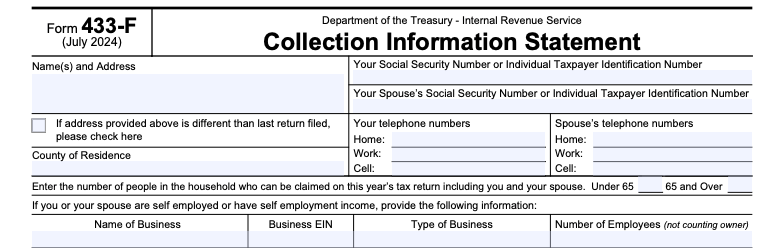
The very top of the 433-F form is basic but easy to overlook. Make sure it’s complete:
- Your complete name, address, and Social Security number (or ITIN).
- Information about your spouse in case you file jointly.
- Family size is less than 65 or 65 or above.
- A box to indicate whether your current address is not the same as your last tax return.
Section A: Accounts and Lines of Credit
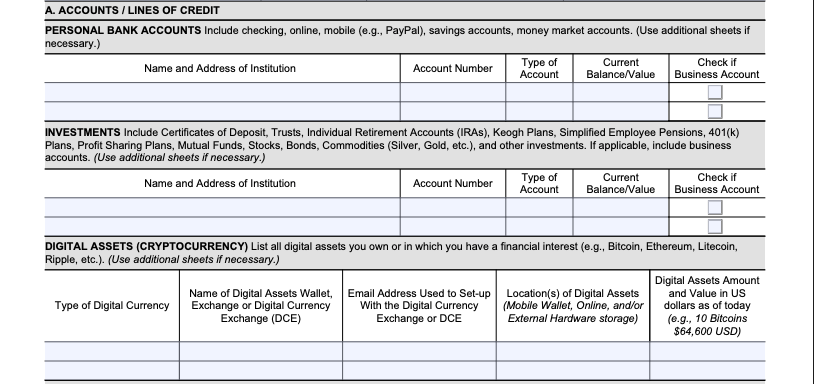
Here you list all financial accounts, even if they have zero balance:
- Checking, savings, money market, or mobile accounts like PayPal.
- Investment accounts such as CDs, IRAs, 401(k)s, mutual funds, stocks, or bonds.
Then report any digital assets:
- Cryptocurrency (Bitcoin, Ethereum, Litecoin, etc.).
- Wallets, exchanges, or storage methods (online, mobile, or hardware wallets).
- Dollar value as of today.
Be sure to include business accounts, too. Do not list loans here, since they are debts, not assets.
Section B: Real Estate
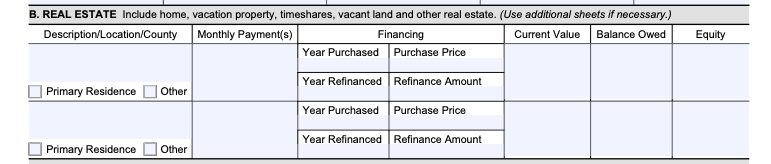
If you own or are paying off property, list it here:
- Primary home, vacation property, rentals, land, or timeshares.
- Show monthly payment, financing details, purchase year, and current market value.
- Subtract what you owe to calculate equity.
Remember, if your taxes or insurance are built into your mortgage, you don’t list them again under housing expenses later.
Section C: Other Assets

This section captures personal and business assets beyond real estate:
- Vehicles (make, model, year, and whether owned or leased).
- Boats, RVs, or other recreational items.
- Whole life insurance policies (show the cash value).
- Business tools, equipment, or inventory.
- Even intangible assets like patents or domain names.
You’ll need to show the current value, the loan balance, and the equity for each.
Section D: Credit Cards

List every credit card or line of credit, even with no balance. For each, include the type, credit limit, current balance, and minimum monthly payment.
Section E: Business Information
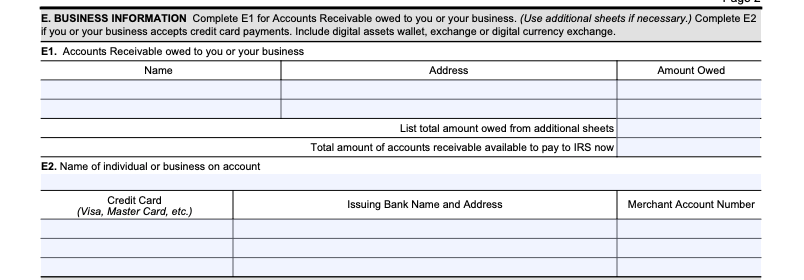
This part is only for self-employed taxpayers:
- E1 – Accounts Receivable: List clients or customers who owe you money, including amounts.
- E2 – Merchant Accounts: Provide details if you accept credit card payments or receive funds through digital wallets or exchanges.
This shows the IRS what cash is expected in the near future.
Section F: Employment Information

For wage earners, list your employer’s name, address, pay frequency, gross pay, and tax withholdings. Do the same for your spouse, if applicable.
If you attach a recent pay stub, you don’t have to complete this section.
Section G: Non-Wage Household Income

Report all other income streams:
- Social Security, pensions, unemployment, or disability.
- Child support or alimony received.
- Rental income (net after expenses, not including depreciation).
- Self-employment net income (after necessary expenses).
- Other sources like partnerships, S-corps, farming subsidies, or IRA distributions.
If rental or business income is negative, enter “0.”
Section H: Monthly Necessary Living Expenses
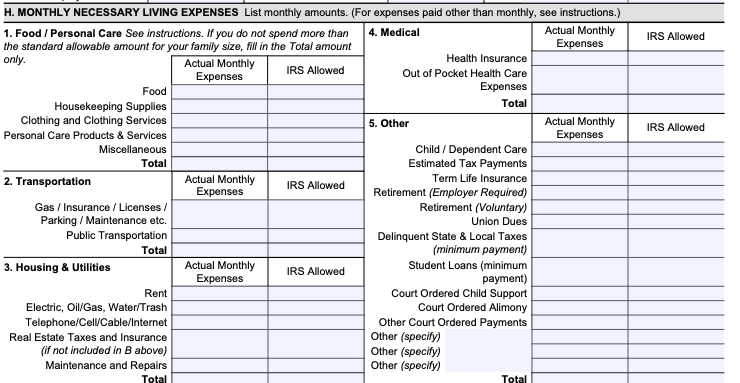
Finally, list your monthly living costs. The IRS compares these with its “allowable standards,” so be honest but ready to prove them. Categories include:
- Food, clothing, and personal care.
- Housing and utilities (not including your mortgage, as that’s in Section B).
- Transportation (fuel, repairs, insurance, public transit).
- Health insurance and out-of-pocket medical costs.
- Child or dependent care.
- Student loans (if federally backed).
- Court-ordered payments like alimony or child support.
- State or local tax payments are still owed.
Bills that are not monthly should be converted (weekly × 4.3, biweekly × 2.17, quarterly ÷ 3).
Final Steps Before Submitting the Form
At the end of Form 433-F, you must:
- Sign and date the form.
- Certify under penalty of perjury that the numbers are true.
- Keep a complete copy for your records.
When you file the form, you are likely to be requested to provide more documents by the IRS. It is easy if you have copies to make a quick response.
Where to Mail IRS Form 433-F?
Where you send the IRS Form 433-F depends on your situation:
- If you received a letter from the IRS, use the mailing address or fax number on that notice.
- If you are working with a revenue officer, send it directly to that officer.
- If you are applying for an installment agreement with Form 9465, send both forms together to the address on your IRS letter.
- Some cases allow you to upload the form securely online or fax it. Follow the instructions in your notice.
Always keep proof of mailing or fax confirmation. Delays in IRS mailrooms are common, so it’s important to have your own record of when you sent the 433 F form.
Other IRS 433 Forms You Should Know
The IRS uses different versions of the 433 depending on your case:
- Form 433-A: A longer version for individuals when working directly with a revenue officer.
- Form 433-B: For businesses that owe payroll or other taxes.
- Form 433-D: Used to set up a direct debit installment agreement.
- Form 433-A (OIC) and 433-B (OIC): Special versions for those applying for an Offer in Compromise.
- Form 433-H: Another payment plan form for direct debit agreements.
File Form 433-F Right With Hopkins CPA Firm
Many taxpayers lose valuable options by not filing the 433-F form correctly, and even small mistakes can cost time, money, or relief. Hopkins CPA Firm is the best choice to guide you through the 433 F form. We review your numbers, prepare the form according to the IRS’s expectations, and support it with the necessary documents.
Contact us today and let us handle the form, the strategy, and the follow-up with the IRS.